In today’s competitive academic environment, practical exposure plays a crucial role in shaping a student’s career. One such valuable opportunity is the final semester project training offered by Physical Research Laboratory (PRL). This program allows students to work on real research projects and gain hands-on experience in science and engineering domains.
Moreover, this training is designed specifically for students who want to bridge the gap between theoretical knowledge and real-world application. In this detailed guide, you will learn everything about PRL project training, including eligibility, duration, benefits, application process, and certification.
Overview of PRL Project Training Program
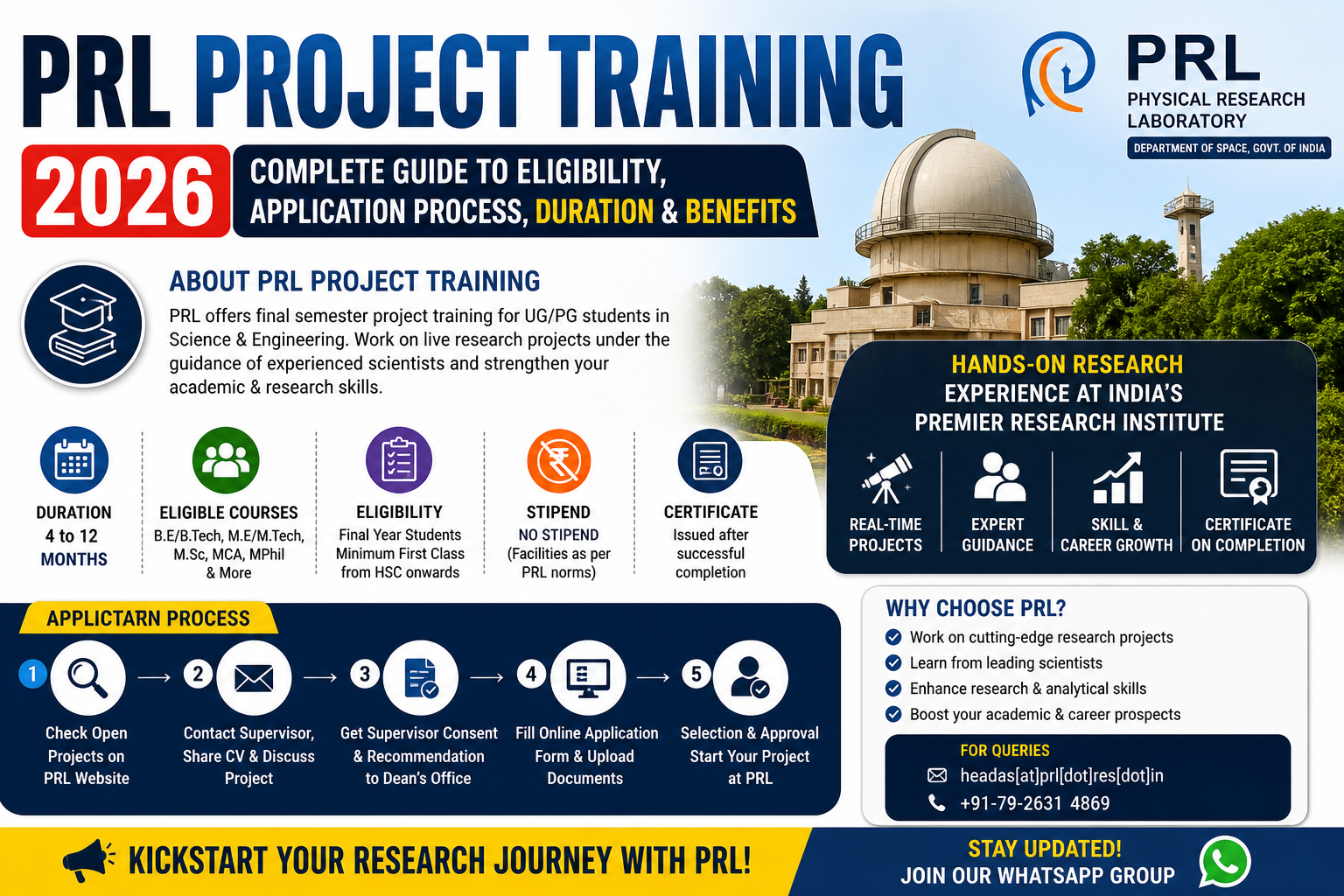
The PRL Project Training Program is intended for final-year undergraduate and postgraduate students pursuing science and engineering courses. Unlike regular internships, this training is deeply integrated into the academic curriculum and focuses on research-based learning.
According to the official guidelines , only bonafide full-time students in their final year are eligible to apply. This ensures that students can align their academic projects with real research work at PRL.
Key Highlights
- Designed for final semester students
- Focus on research and project-based learning
- Duration ranges from 4 to 12 months
- No stipend provided
- Certification awarded after completion
About Physical Research Laboratory (PRL)
Physical Research Laboratory is one of India’s premier research institutions, working under the Department of Space. It is known for its contributions to space science, astronomy, and planetary research.
Therefore, getting an opportunity to work at PRL can significantly enhance a student’s academic profile and open doors to research careers.
Program Details and Duration
The training duration varies depending on the course and specialization. This flexibility allows students from different academic backgrounds to participate effectively.
Duration Based on Course
- Undergraduate Engineering Students: 4 months
- Undergraduate/Postgraduate Science Students: 4 to 6 months
- Postgraduate Engineering Students: 6 to 12 months
Additionally, the training must be a part of the student’s academic curriculum, ensuring alignment with university requirements.
Eligibility Criteria
Before applying, candidates must carefully check the eligibility requirements.
Basic Requirements
- Must be a full-time student in final year
- Must belong to UG/PG programs in science or engineering
- Minimum first class from HSC onwards
Furthermore, students who have already completed their degree are not eligible to apply.
Academic Courses Eligible
Students from the following courses can apply:
- B.E / B.Tech
- M.E / M.Tech
- MCA
- M.Sc
- MPhil
- Other UG/PG science and engineering courses
This wide range of eligible courses ensures that students from various technical backgrounds can benefit from this program.
Important Guidelines for Students
The PRL training program follows strict guidelines to maintain academic integrity and discipline.
Key Instructions
- Training must be part of academic curriculum
- Attendance is mandatory as per committed schedule
- Students must carry ID cards within PRL premises
- Absence without permission may lead to termination
In addition, students must follow all institutional rules and maintain professionalism during the training period.
Facilities Provided During Training
Although the program does not offer financial support, it provides essential facilities for learning.
Available Facilities
- Temporary ID card for campus access
- Computational resources as per project requirements
- Canteen facilities (paid basis)
However, students must arrange their own accommodation, transport, and medical expenses.
Application Process (Step-by-Step)
Applying for PRL project training requires a structured approach.
Step 1: Explore Available Projects
Students must first check the project list on the official PRL website. Only projects marked as “OPEN” are available.
Step 2: Contact Supervisor
Next, students should:
- Send their CV/resume
- Discuss project details
- Obtain supervisor consent
It is important to approach only one supervisor at a time.
Step 3: Wait for Response
Students must wait at least 3 working days before contacting another supervisor.
Step 4: Recommendation Process
If selected, the supervisor will recommend the student to the Dean’s office.
Step 5: Fill Online Application
After recommendation, students will receive an online form to complete the application.
Documents Required
While applying, students need to upload the following:
- NOC cum Recommendation letter (from HoD/Principal)
- Undertaking form (signed)
- Supervisor consent form
Ensure that all documents are properly filled and signed to avoid rejection.
Selection Process
The selection process is competitive and depends on multiple factors:
- Academic performance
- Interaction with supervisor
- Availability of project slots
Additionally, a supervisor can select:
- Maximum 4 students at a time
- Maximum 2 students per project
Internship / Training Structure
The structure of PRL training ensures comprehensive learning.
Training Components
- Project allocation
- Research work under guidance
- Regular progress monitoring
- Final seminar presentation
Moreover, the training mode can be online or offline, depending on project requirements.
Learning Outcomes
Students who complete PRL training gain valuable skills.
Key Learnings
- Research methodology
- Technical problem-solving
- Data analysis and interpretation
- Scientific communication
As a result, students become more confident and industry-ready.
Benefits of PRL Project Training
Although the program does not offer a stipend, its advantages outweigh financial benefits.
Major Benefits
🎓 Academic Enhancement
Students gain practical knowledge that strengthens their academic understanding.
🚀 Career Opportunities
Experience at Physical Research Laboratory adds strong value to resumes.
🧠 Skill Development
Students develop analytical, technical, and research skills.
🌐 Networking
Interaction with experienced researchers helps in career guidance.
Certification Details
Upon successful completion, students receive an official certificate.
Certification Conditions
- Completion of project work
- Final seminar presentation
- Approval from project supervisor
This certificate is highly valuable for higher studies and job opportunities.
Important Rules to Remember
- No stipend or financial assistance provided
- No publication allowed without supervisor permission
- Students must follow PRL security norms
- Evaluation is separate from university assessment
Therefore, students must strictly adhere to all guidelines.
Contact Details
For queries, students can contact:
Head, Academic Services
Email: headas[at]prl[dot]res[dot]in
Phone: +91-79-2631 4869
Why You Should Apply
Opportunities like PRL project training are rare. Even though there is no stipend, the exposure to real research work is unmatched.
Furthermore, working at a reputed institute helps students build a strong foundation for future careers in research, space science, and technology.
Conclusion
The PRL Project Training 2026 program offers an excellent opportunity for students to gain hands-on research experience. With structured guidance, real-time projects, and expert mentorship, this program can significantly shape your academic and professional journey.
If you are serious about building a career in science, engineering, or research, this is an opportunity you should not miss.
👉 For the latest internship updates, project opportunities, and career alerts, join our WhatsApp group today and stay ahead in your journey!